Your Best Promoters Are Already on the Floor
By Pop Reso
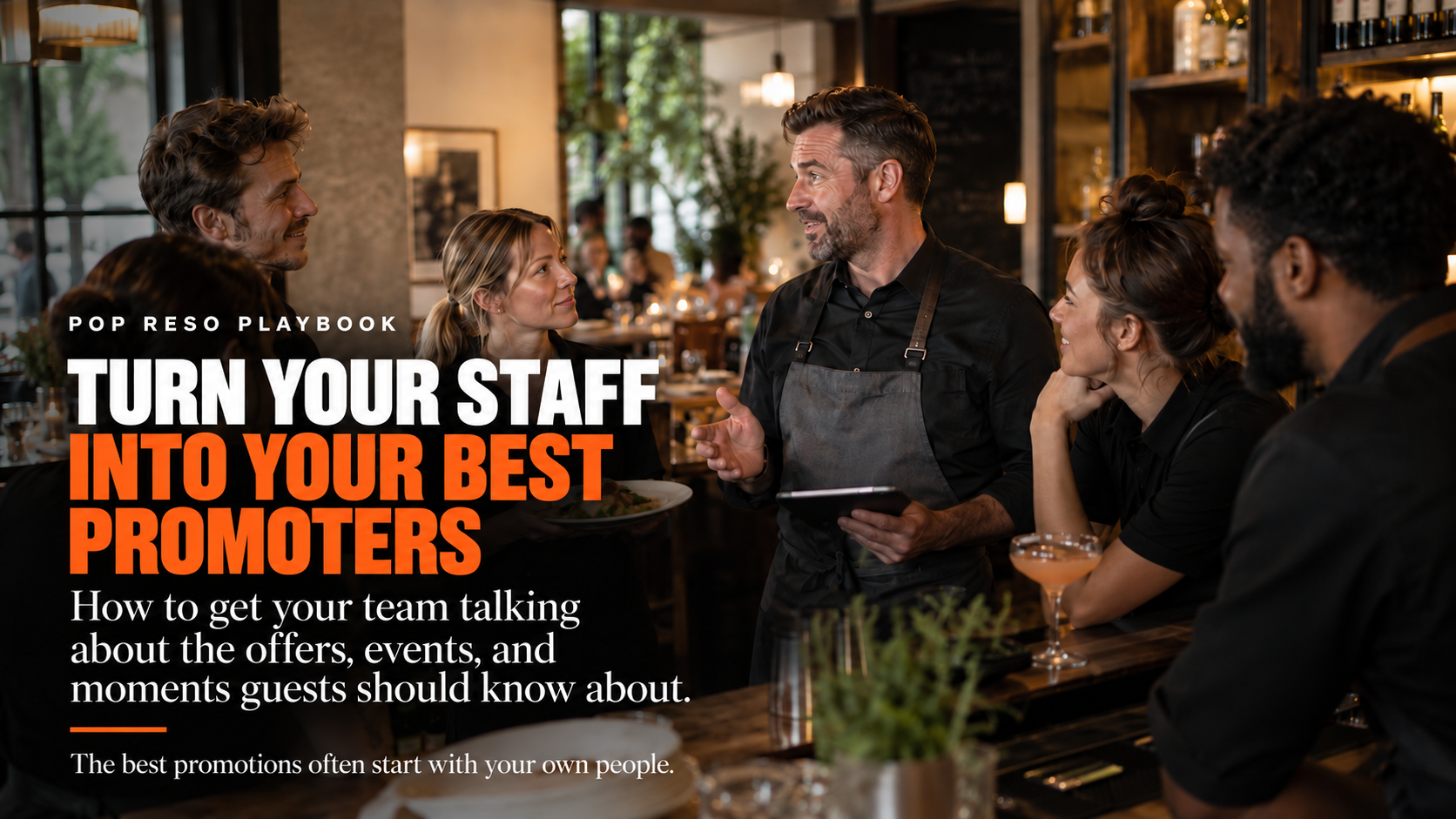
Guests can tell when a recommendation is part of the conversation and when it is part of a sales pitch.
Hospitality venues spend a lot of time thinking about how to reach the people who have not arrived yet. Instagram. Email. Google. Posters. Promotions. A post going live before dinner. All of that matters.
But there is another audience sitting ten feet away from the kitchen almost every night, already talking to your guests.
Your staff.
A server may speak to forty people during a shift. A bartender might have fifty conversations before last call. Hosts are answering questions before guests even sit down.
When those people know what is happening in the restaurant and actually care enough to mention it, promotions stop feeling like advertising. They become part of the experience. That is a very different thing.
“Make Sure You Push the Special” Usually Does Not Work
Anyone who has worked a restaurant shift has heard some version of this during pre-shift.
"We need to move the feature tonight, so make sure everybody is pushing it."
The intention is understandable. The kitchen prepared something. There may be inventory to move. Maybe reservations are soft and management wants to create some energy around the night.
The problem is the word "push."
Nobody wants to be pushed into dinner. Guests usually respond much better when something comes up naturally.
Instead of a server saying:
We have a feature tonight if you’re interested.
there is a world of difference when they can say:
Chef did a short rib tonight that’s been cooking since this morning. I tried a piece before service. It’s really good.
One sounds like an obligation. The other sounds like somebody who knows what is happening in the restaurant.
Let Them Try It
If you want the staff talking about a dish, cocktail or wine, give them a chance to experience it. This is one of those old restaurant habits that still works because it makes complete sense.
Put the feature down at pre-shift. Let everyone have a bite. Pour a small taste of the wine. Let the bartender explain why the new cocktail tastes different from the last one.
You are not just giving staff product knowledge. You are giving them an opinion. That matters.
A server who has tasted the scallops can say:
The brown butter really comes through, and it’s richer than it looks.
A server who has only read a description off the POS can tell you that the dish contains scallops. Those are not the same recommendation. Guests hear the difference.
Give Them the Story, Not Just the Ingredients
Knowing what is in a dish is useful. Knowing why it exists is better.
Maybe the chef found beautiful local tomatoes that morning and built a feature around them.
Maybe the bartender brought back a bottle from a tasting and wanted to put it behind the bar for the weekend.
Maybe Thursday jazz night started because one of the owners used to play in a band.
Those details give staff something interesting to talk about. They also make the restaurant feel like a place where things happen for a reason.
Instead of memorizing:
Halibut, fennel, lemon, capers.
they might remember:
“Chef got the halibut in this afternoon and built tonight’s feature around it.”
That sentence is easier to say because it sounds like something a person would actually say.
Pre-Shift Is Your Best Marketing Meeting
A good pre-shift does not need to be long.
Ten or fifteen focused minutes can completely change how well the floor communicates what is happening that night.
Tell the team:
What is new?
What is limited?
What is happening later?
What should guests know about tonight?
What are people likely to ask about?
If there is live music at eight, everyone should know who is playing.
If there are sixteen portions of lamb shoulder, everyone should know that.
If the patio just opened for the season, the host should know whether guests can request it.
If a new cocktail launches tonight, the server should be able to describe it without disappearing to ask the bartender.
This is not about turning pre-shift into a sales seminar. It is about making sure the people representing the restaurant actually know what is going on inside it.
Give Staff a Sentence They Can Use
Some people are naturally good at describing food and recommending things. Some are not. That does not mean you hand everyone a script and ask them to recite it. Give them a starting point.
If tonight’s feature is a tomahawk for two, the pre-shift note might be:
If somebody is deciding between steaks, mention that the tomahawk is only here tonight and it is designed for sharing.
That is enough. The server can make it their own.
For live music:
If guests are deciding whether to stay for another drink, let them know the music starts at eight.
For a wine feature:
Anyone ordering steak tonight might like to know we opened a Barolo that we normally do not pour by the glass.
Those prompts fit naturally into conversations that are already happening.
Make It Easy to Know What Is Happening
This sounds obvious, but restaurant communication can become surprisingly fragmented.
The bartender knows about the cocktail feature. The kitchen knows about the special. The manager knows there is a DJ coming later. The host knows there is a patio event tomorrow. The server somehow knows none of it.
The easier it is for everyone to see what is happening, the better.
A simple daily rundown can be enough:
Tonight
Chef feature
Cocktail feature
Happy hour ending at 6
Live music at 8
Patio open
Two large reservations arriving at 7:30
Everybody starts the shift with the same picture of the night. That helps service just as much as it helps promotion.
Let Staff Share What They Are Excited About
You do not need every server talking about every feature. In fact, that can start sounding rehearsed very quickly.
One server may love wine. Another knows every beer in the building. Someone else may genuinely get excited about dessert. Use that.
If a server is enthusiastic about the new cocktail, let them talk about the cocktail. If your bartender cannot stop talking about the band coming Friday, that person is probably going to promote the event more convincingly than a sign at the front door ever could.
People sell enthusiasm better than information. You are trying to create enough knowledge that genuine enthusiasm has somewhere to go.
Give Them Something Worth Talking About
Staff cannot manufacture excitement around something that is not interesting.
“Tell everyone we have chicken fingers” is probably not going to light up the floor.
But:
Chef made twelve portions of duck confit tonight.
We are opening a magnum of Barolo at 7.
There is an acoustic duo starting after dinner.
The patio is finally open.
Now there is a story.
This is one reason restaurants should think beyond discounts when planning promotions. Your staff will usually have an easier time talking about something interesting than something cheap.
Let the Team Help Create the Post
There is another opportunity here that venues often overlook. The people working the floor see the your venue differently than management does.
Ask them.
“What would you post about tonight?”
You may be surprised by the answer.
The server might notice that everyone has been ordering the same cocktail. The bartender may tell you the sunset hits the patio perfectly around seven. The host might mention that guests keep asking whether the band is playing again next week.
Those observations can become content.
You do not have to hand over the restaurant’s social accounts to everybody on payroll. You are simply using the people closest to the guest to understand what is worth talking about.
Recognition Can Go Further Than a Contest
You can motivate staff without turning every recommendation into a sales competition. A little recognition goes a long way.
If someone is consistently great at talking about features, mention it at pre-shift.
If a server suggested a post that performed well, tell the team whose idea it was.
If the bartender created the cocktail everyone is posting about, put their name behind it.
People are more likely to participate when they feel like they have some ownership over what the venue is doing. You can use incentives too, but they work best when they are occasional and simple.
Maybe the person who sells the most tasting flights this weekend gets dinner for two.
Maybe the team hits a target together and management buys everyone pizza after close.
Maybe there is no prize at all and you simply keep everybody involved.
Culture lasts longer than a contest.
Be Careful What You Incentivize
There is a downside to pushing individual sales too hard.
Guests can feel it.
If a server earns five dollars every time they sell a certain bottle, the recommendation can start sounding less like hospitality and more like commission.
That does not mean incentives are wrong. It means they should not distort the guest experience.
The goal should never be:
How do we get this table to spend more money?
A healthier question is:
Is there something happening here tonight that this guest would genuinely enjoy knowing about?
That difference is important.
Your Host Team Matters More Than You Think
Hosts are often left out of promotional conversations because they are not taking orders.
That is a mistake.
They are frequently the first and last people a guest speaks with.
A guest walks in without a reservation:
Do you have anything available?
The host could simply seat them.
Or:
Absolutely. We have a table in the lounge, and there’s live music starting at eight if you’d like to stay for it.
Nothing was pushed. The guest was simply given useful information. That is promotion at its best.
Bartenders Have Their Own Advantage
The bar is different because conversations tend to happen more naturally.
A guest sees a bottle:
They ask what somebody else ordered.
They want to know what is new.
That makes bartenders some of the most influential people in the building when it comes to introducing new products.
A bartender who says:
I’ve been playing around with a blood orange Negroni this week. Want to try one?
can probably sell the drink better than a paragraph ever could. That is why it is worth involving them early. If the bartender helped create the feature, they already have something to say about it.
Show the Team That Promotion Actually Matters
Staff are much more likely to care when they can see the result. Tell them when something worked.
“We posted the patio opening at four and had twenty extra covers by six.”
“The tasting sold out.”
“Almost every table asked about the short rib after we put it up.”
“The band night was our busiest Thursday this month.”
Now the promotion is not just another management request. The team sees the connection between talking about what is happening and having a busy room. People tend to enjoy working in busy venues.
Tips are usually better. Energy is better. The shift goes faster. That makes the result relevant to them too.
The Goal Is Not to Build a Sales Team
Your servers are not sales representatives.
Your bartenders are not influencers.
Your hosts do not need marketing scripts.
They are hospitality people.
That is exactly why they can be so effective.
They are already having conversations with guests. They already know the room. They can tell when somebody is celebrating, deciding what to order, looking for another drink or wondering what to do after dinner.
Give them the information.
Let them taste things.
Tell them the story.
Invite them into what the restaurant is doing.
Then let them talk like people.
Because some of the best promotion a restaurant will ever get does not happen on a screen. It happens tableside.