The Story Guests Tell After They Leave
By Pop Reso
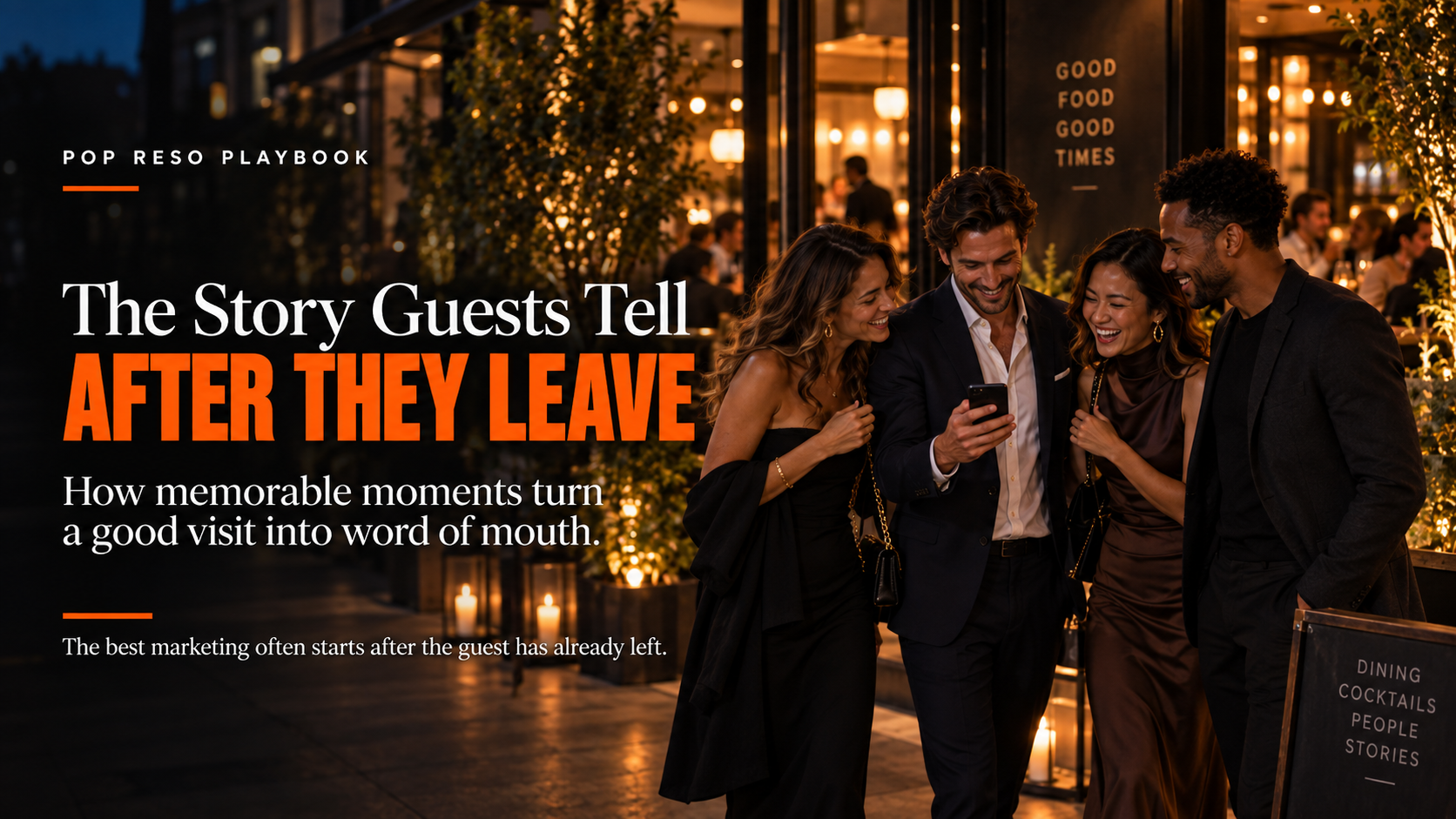
The best marketing often starts after the guest has already left.
A guest can spend two hours in a venue and remember only a few minutes of it.
Not because the rest of the experience did not matter, but because memory does not work like a receipt. People do not leave remembering every drink, every plate, every interaction, and every song in the order they happened.
They remember moments.
The bartender who remembered what they ordered last time. The server who quietly brought an extra plate because they noticed the table was sharing. The birthday dessert nobody asked for. The story behind the wine. The chef who came over to say hello. The song that came on at exactly the right time.
Later, when someone asks, “How was that place?” those are the details that make it into the story.
That is where word of mouth really begins.
Good Experiences Are Expected. Memorable Ones Get Repeated.
Most guests arrive expecting the basics to go well.
They expect the space to be clean. They expect their order to be correct. They expect the drinks to arrive, the staff to be polite, and the experience to feel reasonably smooth.
Meeting those expectations is essential, but meeting expectations alone rarely gives someone much to talk about. Nobody usually texts a friend the next morning to say, “Our glasses were refilled at an appropriate frequency.”
They talk about the unexpected moment.
Maybe they mentioned they were celebrating an anniversary and someone remembered twenty minutes later. Maybe the bartender offered them a taste of something they had never tried before. Maybe a staff member overheard them debating between two dishes and gave them a recommendation that ended up becoming the highlight of the night.
These moments do not have to be extravagant.
Often, the most memorable hospitality is simply evidence that somebody was paying attention.
People Remember How the Night Felt
There is a reason guests sometimes struggle to explain exactly why they loved a venue.
“The vibe was just really good.”
That sentence can mean dozens of things.
It can mean the lighting felt right. The music was perfect for the room. Staff seemed relaxed and confident. The bartender was having fun. The people at the next table were laughing. The pacing felt natural. Nobody rushed them, but they were never forgotten.
The guest may not consciously separate those details, but together they create an emotional impression. That impression is often more powerful than any individual product.
A great cocktail can be copied. A popular dish can be recreated somewhere else. A price can be matched.
The feeling of a night is much harder to duplicate.
That is why hospitality operators should think beyond delivering products and start thinking about what guests will actually remember about being there.
Give People Something Worth Talking About
Word of mouth becomes much easier when the experience contains a story. That does not mean every venue needs a gimmick.
In fact, forced “Instagram moments” can feel more like marketing than hospitality if they have no connection to the place.
The strongest stories usually grow naturally from the venue itself.
A brewery might pour a limited beer made with a local ingredient and tell guests where it came from. A winery might explain why a particular vintage tastes different from the year before. A lounge might have an off-menu cocktail connected to the bartender who created it. A hotel bar might revive a drink from the property’s history.
Even something as simple as a chef feature becomes more memorable when there is a reason behind it.
“Tonight we have halibut” gives information.
“Our chef found beautiful halibut this morning, so we built tonight’s feature around it” gives the guest a story.
Stories give people language. And when guests have language, they are more likely to repeat it.
Your Team Creates More Word of Mouth Than Your Marketing Department
The people closest to the guest have the greatest opportunity to create memorable moments.
A server noticing that a guest always orders sparkling water.
A bartender remembering someone’s name.
A host recognizing a returning couple.
A tasting-room employee remembering which wine a guest liked on their last visit.
None of these things need to be scripted. In fact, they are usually better when they are not.
The best service teams understand the venue well enough to make small decisions without waiting for instructions. They know when to offer a taste, when to make a recommendation, when to give someone space, and when a simple gesture would mean something.
This is where strong pre-shifts and good internal communication start to matter.
If a team knows there is a birthday at table twelve, a regular returning at six, a new feature from the kitchen, or a couple visiting for the first time, they have more opportunities to make the experience personal.
Personal experiences become memorable experiences. Memorable experiences become stories.
Social Sharing Usually Starts With a Real Moment
There is often too much pressure placed on creating content specifically for social media.
The more useful question is: Is anything happening here that guests naturally want to share?
A beautifully presented dish can do it.
So can a dramatic cocktail pour, a great view, a live performance, a tasting flight, an unexpectedly thoughtful dessert, or simply a table full of friends having a genuinely good time.
The strongest user-generated content usually comes from real experiences first and phones second.
Guests are not thinking about helping your marketing strategy. They are sharing because something looked good, felt special, made them laugh, surprised them, or made them want their friends to know where they were.
That distinction matters.
Instead of asking how to get more people to post about the venue, ask whether the experience is giving them anything worth posting.
The second question usually leads to better hospitality.
The Last Few Minutes Matter Too
Operators often focus heavily on the arrival, but the ending of the experience has its own influence on what guests remember.
A great visit can finish strangely if the bill takes forever, nobody acknowledges the table leaving, or guests walk past three staff members without anyone saying goodnight.
The departure is the final impression.
A sincere thank-you, a host holding the door, a bartender saying, “See you next time,” or a server remembering where the guests said they were heading afterward can leave the experience feeling complete.
Those interactions are small, but they help close the story. The guest leaves feeling like they were hosted, not simply processed. And that feeling tends to travel with them.
You Cannot Control the Story, but You Can Give It Better Material
Every guest leaves with some version of the experience in their head.
Most of those stories will never become online reviews. They will happen privately at work, in group chats, in cars on the way home, and over coffee a week later.
“Have you been there?”
“Yeah, we went last weekend.”
Then comes the part that matters.
What do they say next?
That answer is shaped by dozens of small moments your venue created along the way.
The goal is not to manufacture a perfect story or turn every guest into a promoter. People can feel when hospitality becomes transactional.
The better approach is to create a venue worth talking about. Pay attention. Give the team room to be human. Tell the stories behind what you serve. Create moments that feel specific to the night, the place, and the guest.
When the experience gives people something to remember, the marketing often takes care of itself. Because the most convincing recommendation is still the one that starts with:
You have to try this place.