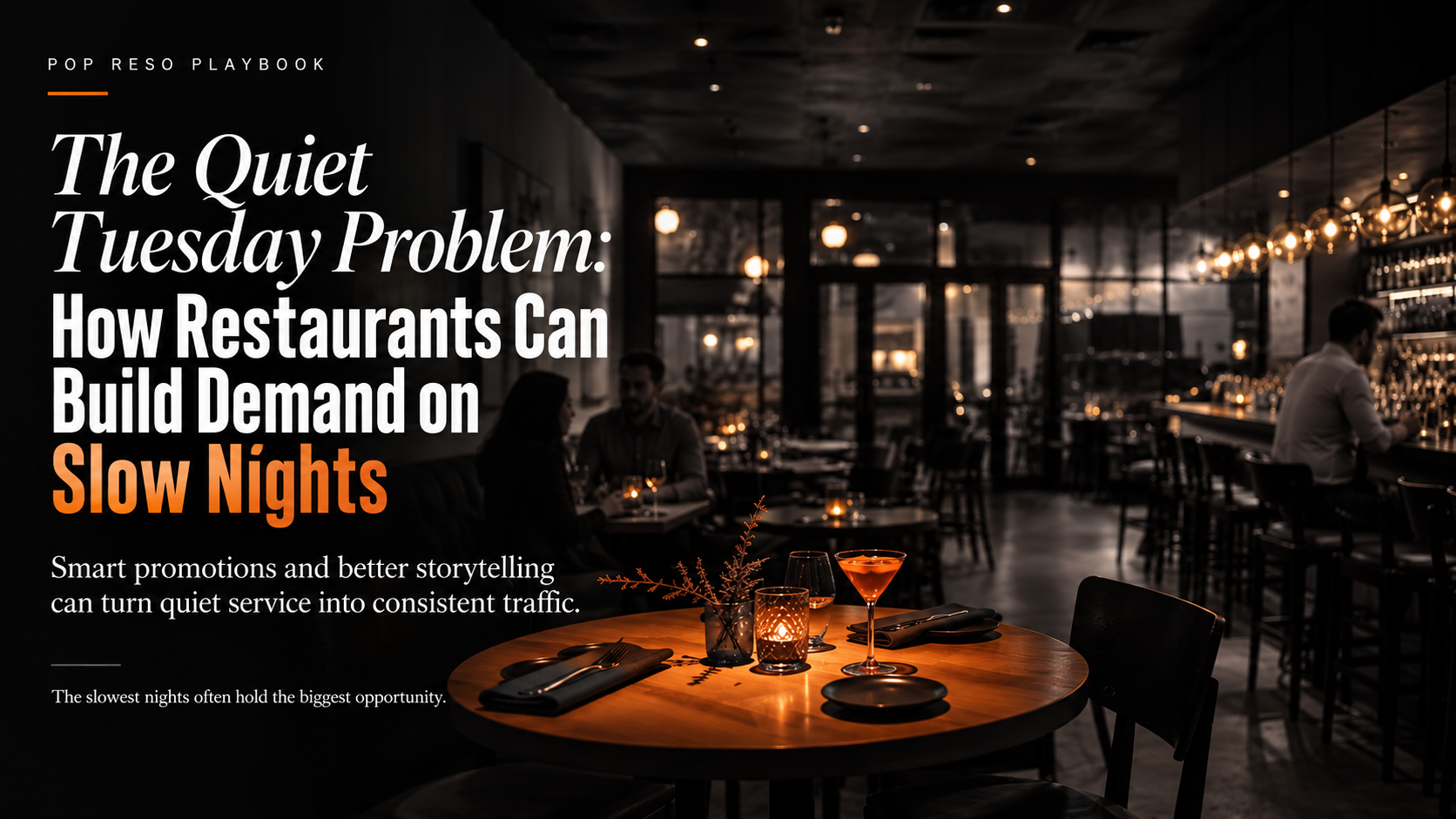
The Quiet Tuesday Problem: How Restaurants Can Build Demand on Slow Nights
By Pop Reso
Every restaurant has nights that are harder to fill. The goal isn’t necessarily to make them cheaper, it’s to make them worth remembering.
Friday and Saturday usually have momentum built into them. People are already thinking about going out, meeting friends, having dinner or grabbing drinks. Tuesday is different. A restaurant can have great food, a talented team and an inviting room, yet still look around halfway through service and wonder where everybody is.
That doesn’t automatically mean something is wrong with the restaurant. In many cases, the problem is simply that Tuesday hasn’t given people a reason to think about it. Guests may like the restaurant perfectly well, but liking a place and deciding to visit it tonight are two different things.
The opportunity is to turn a traditionally slow night into something recognizable. Not necessarily bigger, louder or cheaper, just more distinct.
Give the Night an Identity
A quiet night becomes much easier to market when it means something.
“Come see us Tuesday” doesn’t give a guest much to hold onto. “Tuesday Pasta Night,” “Chef’s Test Kitchen,” “Neighbourhood Wine Night” or a rotating seasonal feature creates a mental shortcut. Instead of asking people to remember another restaurant promotion, you’re giving them a recurring experience they can associate with a particular day.
The strongest ideas usually make sense for the restaurant itself. A neighbourhood Italian restaurant doesn’t need to suddenly become a nightclub because Tuesdays are slow. It might simply feature a different handmade pasta every week. A wine bar could open a few interesting bottles normally offered only by the bottle and pour them by the glass for one evening. A steakhouse might showcase a less familiar cut, while a casual restaurant could build the night around a rotating comfort-food feature.
The point isn’t novelty for the sake of novelty. It’s giving the evening a personality that fits naturally with what the restaurant already does well.
Consistency Is What Builds the Habit
One-off events can create a busy night, but recurring ideas have the potential to change behaviour.
If guests know something happens every Tuesday, they don’t need to rediscover the promotion each week. Eventually, the association becomes automatic. Tuesday starts to mean pasta night, live jazz, chef features or whatever the restaurant has chosen to own.
That kind of consistency is particularly valuable because restaurants are competing with habits as much as they are competing with other restaurants. People already have routines. They cook at home, order delivery, go to the same neighbourhood bar or simply stay in after work. Creating a successful slow-night program means gradually inserting the restaurant into one of those routines.
That takes time. Abandoning an idea after two quiet weeks can prevent it from ever having the chance to become familiar. A good concept needs consistency, communication and enough repetition for people to remember it.
Make It Feel Special Without Making It Cheap
Price can certainly play a role, but a slow-night strategy doesn’t have to begin with a discount.
Limited availability can create interest on its own. A chef might prepare only twenty portions of a feature. A bartender could introduce one new cocktail every Tuesday. A restaurant could open a particular bottle, bring in a local musician or create a small off-menu dish available only that evening.
Those ideas give guests something they can’t simply come back for whenever they feel like it. There is a reason to visit now, but the restaurant hasn’t reduced the perceived value of the experience.
That distinction matters. “Half price because Tuesday is slow” communicates something very different from “This only happens on Tuesdays.”
One is built around price. The other is built around discovery.
Tell People While Tuesday Is Still Tuesday
A great slow-night idea won’t help much if nobody hears about it until Wednesday.
Restaurants often promote events well in advance and then go quiet as the actual night approaches. A post several days earlier is useful, but it shouldn’t be the last time guests hear about what’s happening. Someone who wasn’t thinking about dinner on Sunday may suddenly be looking for somewhere to go at 5:30 Tuesday afternoon.
That is the moment when timely communication becomes valuable.
Show the feature being prepared. Share the room before service. Introduce the musician who is setting up. Post the cocktail being poured. Let people know there are still tables available. The closer the message is to the actual decision, the easier it becomes for someone to turn interest into a visit.
Restaurants aren’t only competing for awareness. They’re competing for attention at a particular moment.
Not Every Slow Night Needs to Become Saturday
There is also value in being realistic. The objective isn’t necessarily to make Tuesday look like Saturday night.
A quieter evening can have its own appeal. Guests may enjoy being able to linger longer, talk to the bartender, sit at their favourite table or experience the restaurant at a more relaxed pace. For some restaurants, success might mean adding twenty covers to a night that previously struggled, not creating a line out the door.
The important question is whether the restaurant is making the most of the capacity it already has.
A slow night represents unused tables, available staff and an experience that is already there waiting to be enjoyed. Before deciding that the answer must be another discount, it’s worth asking a different question:
What could make someone look forward to Tuesday?
Sometimes the answer is surprisingly simple. Give the night an identity, make it worth talking about and keep showing people what’s happening.
Because an ordinary Tuesday doesn’t have to stay ordinary.