The Energy Effect: Why a Busy Room Feels Better
By Pop Reso
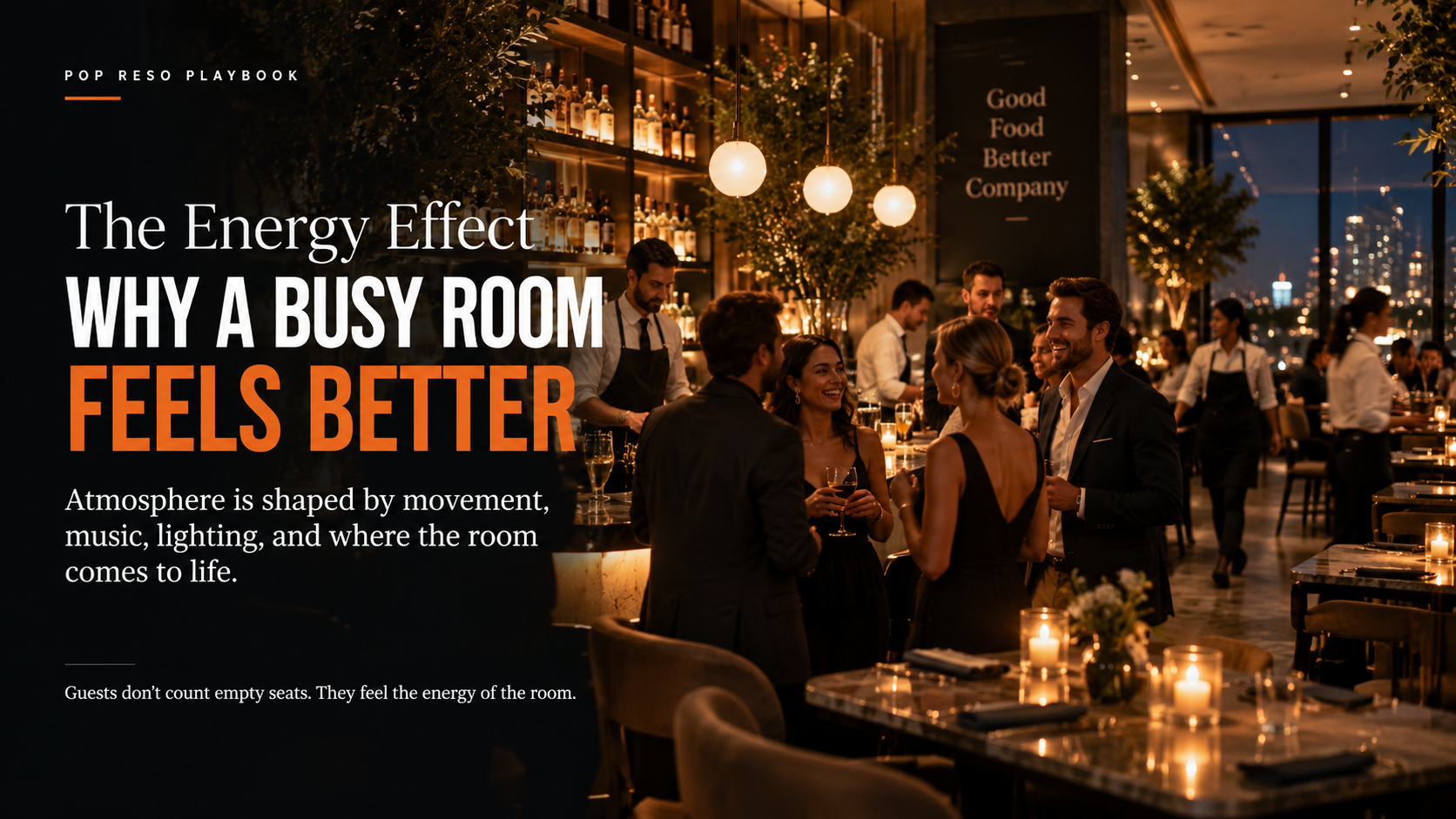
Guests don’t count empty seats. They feel the energy of the room.
There is a moment early in service when a room can go one of two ways.
A few guests have arrived. The lights are on. Music is playing. Staff are moving through the space, checking tables, polishing glassware, dropping drinks, greeting new arrivals. There may still be plenty of empty seats, but the room already feels like something is happening.
Then there is the opposite.
The same number of guests are scattered across a large space. A server stands near the POS. The music is barely noticeable. Empty tables dominate the sightlines. The room is technically open, but it does not quite feel alive yet.
Guests notice that difference immediately.
They may not consciously analyze it, but they feel it. One room says, “You picked a good place.” The other can quietly make them wonder if they should have gone somewhere else.
That is the energy effect.
A Busy Feeling Is Not the Same as a Full Room
Operators sometimes assume atmosphere only arrives once enough people walk through the door.
It does not.
A venue can feel energetic at 40 percent occupancy and strangely flat at 70 percent. The difference often comes down to how the room is being used.
Where guests are seated matters. If the first four parties are spread across four different sections, the room can feel sparse. If those same guests are seated closer together, especially near the bar, windows, fireplace, open kitchen, stage, or another natural focal point, the space starts to feel more active.
This is not about stacking guests on top of one another. It is about creating pockets of life.
The same thinking applies to hotels, wineries, breweries, lounges, and larger venues. A half-empty patio can feel quiet when everyone is spaced apart. Put people around the best view, the fire tables, or the bar and suddenly the room has a center of gravity.
People are drawn to people.
A little social density creates comfort, curiosity, and momentum.
The First Guests Set the Tone
Early guests are more important than they realize.
They are not just customers. They are part of the atmosphere the next guests walk into.
A couple having drinks at the bar, a group sharing food near the entrance, or a table laughing close to the center of the room can make the venue feel active before the night really gets going.
This is why the first seating decisions of the evening deserve some thought.
If every early table is placed deep in a quiet corner, the room can look empty from the doorway even when several parties are already inside. On the other hand, placing some of those guests where they naturally contribute to the visual energy of the room creates an immediate difference.
Guests walking in see movement. They hear conversation. They see drinks landing and plates moving.
That feeling matters.
Hospitality is partly about reassurance, and a room with visible life tells people they have arrived somewhere others also wanted to be.
Staff Movement Is Part of the Atmosphere
A venue can have guests and still feel oddly still.
Staff movement changes that.
A bartender shaking a cocktail, a server carrying plates across the room, someone lighting candles, a host greeting guests, a team member checking the patio or setting the next table all create subtle signals that service is happening.
The key word is purposeful.
There is a big difference between staff moving through a room with intention and staff pacing because they are bored.
Guests can feel both.
When the room is slower, there is often a temptation for staff to gather near the service station or stand at the bar waiting for something to happen. Unfortunately, that can make the venue feel even quieter.
A better approach is to keep the room gently moving. Reset tables. Check details. Walk the floor. Engage the guests who are already there. Prepare visibly for what is coming next.
Energy can be contagious.
Staff create some of it, guests create some of it, and one feeds the other.
Music Can Change the Room Without Anyone Noticing
Music is one of the easiest ways to influence the feel of a venue, yet it is often treated like background decoration.
Volume, tempo, and style all affect how people perceive the room.
If the music is too soft early in the evening, every conversation becomes exposed. A quiet room feels even quieter because guests can hear every chair move and every fork hit a plate.
Turn the music up slightly and the same space suddenly feels more relaxed.
As the night gets busier, the playlist can evolve with it. The goal is not to make every venue loud. A wine bar, hotel lounge, brewery, and late-night cocktail venue should not all sound the same.
The goal is to make the music support the mood you are trying to create.
The best operators understand this instinctively. They know when the room needs a little more tempo and when it needs to settle.
Music is not just something guests hear. It changes how the room behaves.
Lighting Tells Guests What Kind of Night They Are Having
Walk into a venue with bright overhead lighting at 8:30 at night and the entire experience changes.
Even beautiful spaces can feel wrong when the lighting is wrong.
Warm, layered lighting tends to make rooms feel intimate and occupied. Pools of light over tables, bar lighting, candles, sconces, and carefully controlled ambient light create depth. Empty areas disappear slightly while the active parts of the venue feel more prominent.
That is especially valuable on slower nights.
You do not need to illuminate every unused table as though it is waiting to be inspected.
Let the room breathe.
Highlight the areas where guests are actually sitting. Create warmth around them. Allow the darker parts of the space to become background rather than a visual reminder of unused capacity.
Good lighting makes a room feel intentional.
And intentional rooms almost always feel better than brightly lit empty ones.
The Bar Can Be the Engine of the Room
In many venues, the bar is the natural source of energy.
It has movement, conversation, sound, bottles, glassware, lighting, and often a direct view into service. Even when the dining area is slower, a lively bar can make the entire venue feel more active.
This is one reason operators should think carefully about where walk-ins, early guests, and solo visitors are encouraged to sit.
A couple having drinks at the bar adds more energy than the same couple hidden at a distant two-top. That does not mean pushing everyone to the bar. It simply means recognizing its role in the room.
The bar is often where the venue looks most alive. Use it.
The same idea applies elsewhere. At a winery, it may be the tasting counter. At a brewery, it may be the tap wall. At a hotel, it may be the lobby bar. At a live venue, it may be the space around the stage.
Every venue has a natural energy center. Find yours and build around it.
Do Not Let Slow Nights Look Like Slow Nights
There is a psychological trap that happens when the room is quiet.
Staff slow down. Music feels softer. Lights feel brighter. Guests are spread out. The whole venue begins to project the fact that business is slow.
Once that happens, the room can become self-reinforcing.
Guests walk in and sense the quiet. They stay for one drink instead of two. They leave earlier. Staff become more subdued. The room loses even more momentum.
The solution is not to fake a party that is not happening.
It is to protect the atmosphere.
A slower night can still feel warm, intimate, interesting, and desirable. That may mean closing an unused section, concentrating seating, adjusting the lighting, raising the music slightly, encouraging activity around the bar, and making sure the team stays engaged.
You are not pretending the venue is full.
You are making the guests who are there feel like they are part of something good.
Energy Is Part of the Guest Experience
Operators spend a lot of time thinking about service standards, food quality, drink programs, design, and marketing.
Energy sits quietly between all of them.
It is affected by who is in the room, where they are sitting, what they are hearing, what they are seeing, how staff are moving, and whether the venue feels like it has momentum.
Guests may never say, “The seating density was excellent tonight.”
They may never comment on the tempo of the playlist or the fact that the host seated them near the most active part of the room.
They simply leave thinking, “That place had a great vibe.”
That is the result. And when a venue consistently feels good, people want to return. They bring friends. They stay longer. They order another round. They recommend it.
A great atmosphere is not always created by a packed house. Sometimes it begins long before the room fills.