The 5 PM Decision: How Guests Choose Where to Eat Tonight
By Pop Reso
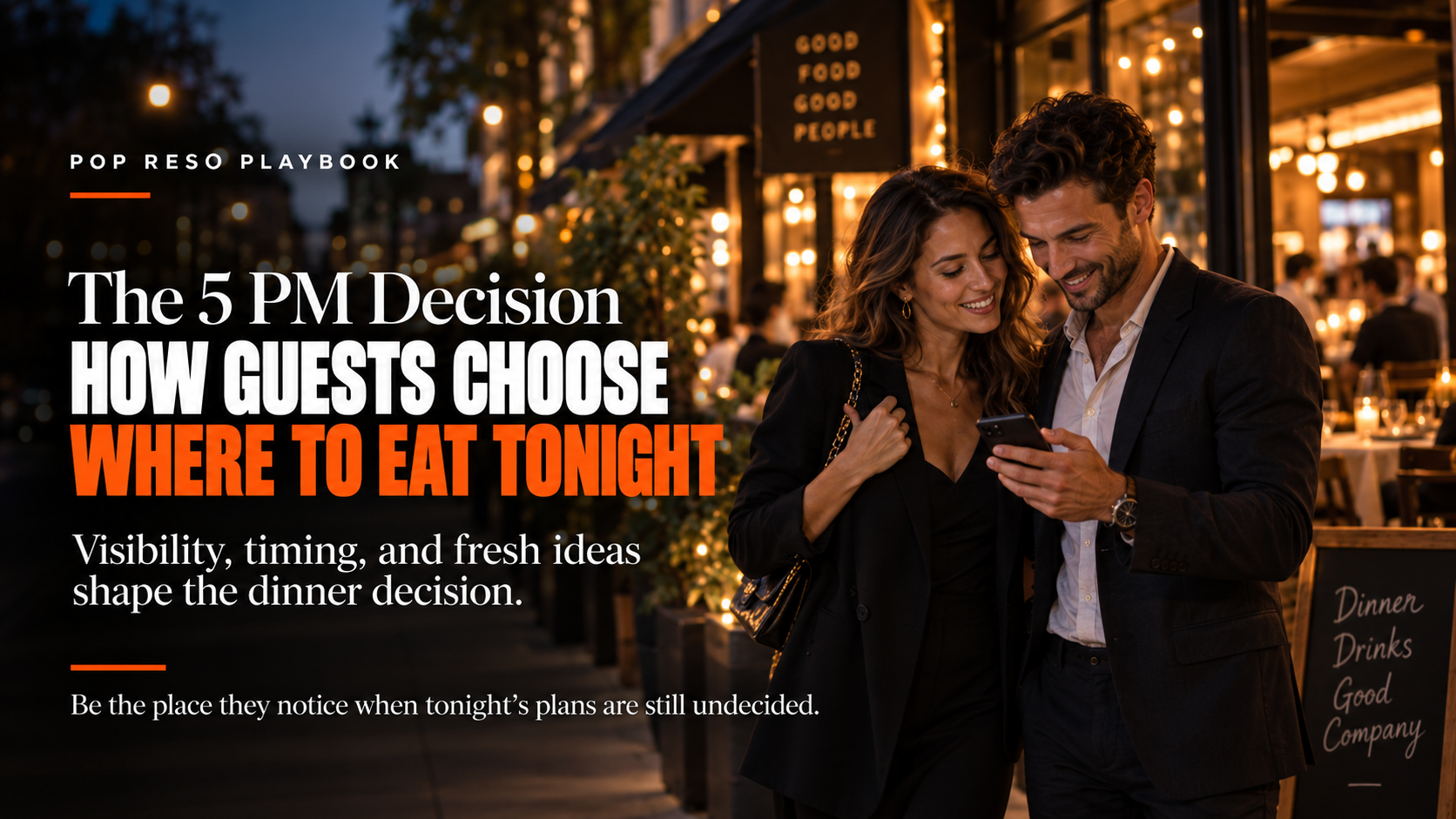
Guests do not always need a discount. Sometimes they just need a reason to choose you tonight.
Around five o’clock, dinner stops being an abstract idea.
People leave work, look in the fridge, send a text to a friend or partner, and start asking the same question:
Where should we go tonight?
For venues, that short window between “we should go out” and “let’s book somewhere” is incredibly important. Guests are not always planning dinner days in advance. Quite often, they are making the decision an hour or two before they want to eat, which means the venue that gets noticed at the right moment has a real advantage.
The interesting part is that guests are not necessarily searching for one specific venue. Many are simply looking for a reason to go somewhere.
Maybe the weather is perfect for a patio. Maybe they see a chef feature that looks incredible. Maybe there is live music starting at seven. Maybe a bartender has created a cocktail that catches their eye. Maybe a restaurant they have been meaning to try suddenly reminds them it exists.
That is the five o’clock decision.
Guests Are Choosing an Evening, Not Just a Meal
Hospitality marketing often focuses heavily on the permanent things: the menu, the dining room, the chef, the concept, the reputation.
All of those things matter, but they do not always answer the most immediate question a guest is asking.
Why should we go there tonight?
A venue may have an excellent menu every night of the week, but something happening right now gives the guest a reason to act. That could be fresh pasta being made for service, oysters arriving that afternoon, a patio opening for the first warm evening of the year, a limited steak feature, or simply a dining room that is starting to come alive.
The distinction is subtle but important.
“Come have dinner with us” asks someone to make a decision.
“Fresh tagliatelle with braised short rib tonight until it’s gone” helps make the decision for them.
The second message gives the guest something to picture. It feels current, specific, and connected to tonight rather than to some future visit they may or may not remember.
Timing Changes the Meaning of the Message
A beautiful food post at 10:00am may earn a like.
That same post at 5:15pm may earn a reservation.
The content has not changed, but the guest’s mindset has.
At 5:00pm, people are hungry, plans are forming, and the distance between seeing something and acting on it becomes much smaller. That makes timing one of the most underrated parts of hospitality marketing.
This does not mean the need to flood social media every afternoon. It means operators should think about content in the same way they think about service. What does the guest need at this particular moment?
Earlier in the week, the goal might be awareness. On Friday afternoon, it might be reminding people about live music. On a quiet Tuesday, it might be showing a chef feature that gives someone a reason to change their plans.
Good hospitality has always depended on reading the room. Good marketing is not all that different.
The Best Reason to Visit Is Often Already in the Building
Venues sometimes feel pressure to invent promotions when they already have plenty worth talking about.
A chef walking through the kitchen knows what is especially good that night. A bartender knows which new drink guests keep ordering. Servers know which dishes are getting the strongest reactions. A manager knows whether the patio looks fantastic or whether there are still a handful of prime reservation times available.
Those are marketing opportunities.
They do not need to be polished campaigns. In many cases, a quick photo or short video from inside the venue feels more convincing because it is happening in real time.
Hospitality is full of small moments that make people want to be there. The challenge is letting people outside the building see them.
That is especially useful for independent operators, which can move much faster than large chains. A chef can decide on a feature in the afternoon and have it in front of guests that evening. A restaurant can react to weather, ingredients, events, or the mood of the room.
That flexibility becomes valuable when it is visible.
Slow Nights Need a Reason of Their Own
Friday and Saturday usually have built-in demand. Tuesday rarely does.
That is exactly why slower nights deserve more thought.
Trying to turn Tuesday into a cheaper version of Saturday is not always the answer. Sometimes the better approach is to give Tuesday its own identity.
Maybe Tuesday becomes fresh pasta night. Wednesday becomes oysters and martinis. Thursday becomes the night the chef runs a rotating feature. A local musician plays twice a month. The bartender creates one off-menu drink every week.
Over time, those ideas can become habits.
Instead of guests thinking, “Where should we go tonight?” they begin thinking, “Isn’t Tuesday the night they do that pasta?”
That is a much stronger kind of demand because it is built around identity rather than discounting.
Price can influence a decision, but it is only one reason people go out. Curiosity, atmosphere, scarcity, social energy, and the feeling that something interesting is happening can be just as powerful.
Make the Decision Easy
Once someone is interested, the venue should remove as much friction as possible.
If a guest sees tonight’s feature, can they immediately tell when it is available? Can they book a table? Can they call? Can they see where the venue is? If there is music, do they know what time it starts?
Ambiguity slows people down.
A guest should not have to dig through old posts, menus, and websites to understand what is happening tonight.
This is also where tools like Pop Reso can fit naturally into a restaurant’s marketing mix. The idea is not to replace Instagram, a website, or a reservation platform. It is to make what is happening right now easier for guests to discover when they are already deciding where to go.
That immediate layer matters because timing matters.
Be the Venue They Notice at the Right Moment
The venue that wins the five o’clock decision is not necessarily the cheapest venue or the venue with the biggest following.
Often, it is simply the place that gave the guest the clearest reason to go.
A great dish. A busy patio. Live music. A chef feature. A table opening. Something that feels timely enough to turn “maybe we should go out” into “let’s go there.”
Venues already create these moments every night. The opportunity is making sure people know they are happening. Because at five o’clock, someone nearby is deciding where to eat. And your venue only needs to give them one good reason.